630 W panel, module efficiency ≥ 22,5%, protection rating IP68. Imported through official channels with full CO · CQ paperwork.
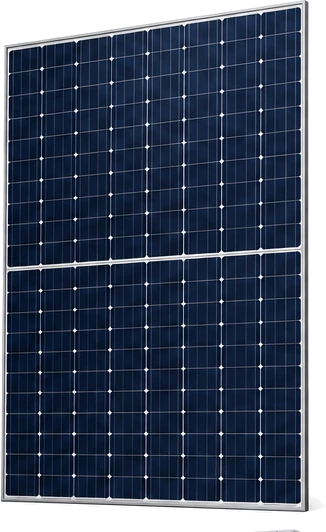
The 630 W Mono panel sits in the 620 – 720 W range Asia Energy imports through official channels, with full CO · CQ paperwork for every shipment. Stocked in Hanoi and Ho Chi Minh City, delivered nationwide.
Module efficiency of ≥ 22,5% tells you how much of the sunlight falling on each square metre becomes electricity. The area follows from it: one 630 W panel takes up no more than about 2,8 m² of roof, and each kWp needs roughly 4,4 m². This is arithmetic from the definition of efficiency, not a measured figure for a given shipment.
Half Cell construction cuts each photovoltaic cell in two, so the current through each half drops by half and resistive losses in the busbars fall with it. The panel is also split into two halves wired in parallel: if a tree or a chimney shades one half, the other keeps producing.
An IP68 rating means fully dust-tight and able to withstand prolonged immersion — what a Vietnamese roof needs, with its long rainy season and construction dust.
Every panel Asia Energy distributes carries a performance warranty of up to 25 years and a free roof survey within 48 hours. Quotes are available three ways: OEM manufacturing under your own brand, a distribution franchise, or retail with full installation.
Other panels
Further reading
FAQ
About 2,80 m². That figure comes straight from the two numbers in the table above: 630 W divided by an efficiency of ≥ 22,5% times 1,000 W/m². A real layout also needs gaps between panels and a maintenance walkway, so the roof area actually used is usually 15 – 20% more than this.
A 3 kW system needs 5 panels, 5 kW needs 8, 10 kW needs 16 — system size divided by 630 W, rounded up. That is roughly 14,0 m², 22,4 m² and 44,8 m² of clear roof. A south-facing pitch yields most; east or west still works but needs extra panels to compensate.
A half-cell panel cuts each photovoltaic cell in two, so only half the current flows through each half. Resistive loss rises with the square of the current, so halving it cuts that loss fourfold — the panel runs cooler and yields more from the same area. The advantage shows most on a partly shaded roof: if a shadow falls on the lower half, the upper half keeps working instead of the whole panel dropping with it.
IP68 is the rating of the junction box on the back of the panel, which holds the bypass diodes and the two output leads. The glass and the aluminium frame are watertight by construction. In practice water gets in not at the panel but at a sloppy outdoor cable joint — MC4 connectors must be crimped to the right cable size and tightened properly, or the panel's own rating will not save you.
Twelve years on the product and twenty-five years on performance. The two are different: the 12 years cover physical faults — cracked glass, a failed junction box, delamination. The 25 years are a yield commitment, meaning the panel must still hold most of its original output after 25 years. CO · CQ paperwork comes with every batch.
Asia Energy
No volume commitment, no deposit. Thirty seconds to fill in and an Asia Energy engineer will call you back.
Asia Energy will be in touch within 24 working hours.